Agents Need Search, Not Bigger Toolboxes
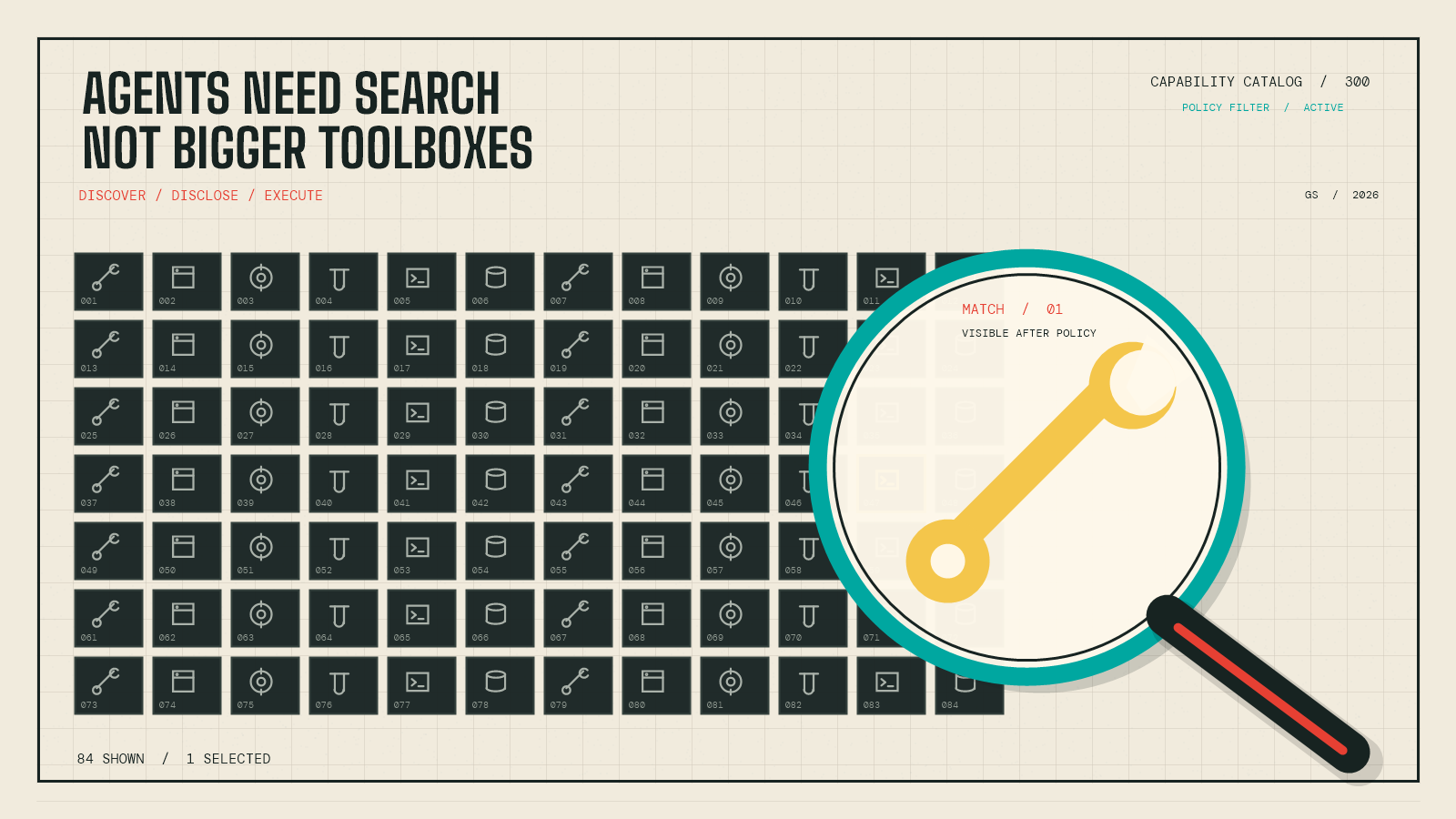
Large tool catalogs make agents less efficient unless the harness filters by policy, searches the eligible set, and discloses only the selected interface.
We are giving AI agents bigger toolboxes when what they need is search.
A few tools can be loaded into a model’s context. Hundreds cannot be treated the same way without paying in tokens, latency, and selection errors. Anthropic describes one five-server setup where 58 tools consumed roughly 55,000 tokens before work began. Its Tool Search tests reduced tool-definition usage by 85% and improved selection accuracy in large MCP catalogs.
The lesson is larger than one implementation: abundance needs navigation. Search did not replace HTTP; it made the web navigable. Tool search will not necessarily replace the Model Context Protocol either. It will make MCP one adapter behind the agent harness’s capability index.
MCP solves a different problem
MCP gives clients a standard way to connect to servers, list tools, inspect schemas, and invoke them. But discovery is scoped to servers the host already knows and has connected. The official architecture shows a host creating a client for each server, then combining tools/list results from those connections. It does not define search across every server, API, SDK, command-line tool, browser action, or internal function.
This distinction matters because requiring every capability to arrive as a dedicated MCP server creates another packaging bottleneck. Many organizations already have maintained OpenAPI descriptions, SDKs, CLIs, internal functions, and HTTP endpoints. The harness should be able to index those capabilities without pretending they all use the same transport.
MCP remains valuable for describing and calling tools. It stops being the admission ticket to discovery.
The harness needs a capability index
A capability index is more than names and JSON schemas. Each record should describe outcomes, examples, inputs and outputs, side effects, reversibility, scopes, data classifications, provenance, trust, cost, latency, and execution adapter.
When an agent needs to act, the harness should use that index in stages:
- Filter the catalog by identity, tenant, current data classification, region, and permitted side effects.
- Retrieve a small candidate set with fast lexical or embedding search.
- Rerank the shortlist for task fit, trust, cost, latency, and risk.
- Load only the selected interface and adapter instructions into context.
- Revalidate arguments and authorization, execute, validate the result, and record the outcome.
That separation is important. Policy decides which capabilities may be discovered. Semantic judgment ranks the eligible candidates. Code retains control of execution.
Reranking can use a conventional model, specialist classifier, learned ranker, or typed judgment system such as TypeSafe. Those are implementation choices. The architecture’s premise is progressive disclosure: the model sees what it needs, when it needs it, rather than carrying the whole catalog through every turn.
I tested the pattern in a governed agent harness
I added tool search to my Governed Copilot SDK using the capability built into @github/copilot-sdk, not another retrieval system. The SDK can defer external schemas behind tool_search_tool after a configurable threshold, defaulting to 30 tools. My layer overrides search so governance is applied before ranking.
The override applies the active profile’s allow and deny rules and removes tools whose data classification is unreachable. Only eligible tools are ranked and returned. Invocation still passes through normal authorization hooks, so filtering discovery does not replace enforcement at execution time. All 16 tests pass, covering registration, policy filtering, classification reachability, ranking, and result limits.
A synthetic benchmark shows why the threshold matters:
| Tools | All schemas upfront | With search | Estimated reduction |
|---|---|---|---|
| 10 | 1,455 | 1,521 | -5% |
| 30 | 4,375 | 2,248 | 49% |
| 60 | 8,755 | 2,248 | 74% |
| 120 | 17,525 | 2,248 | 87% |
| 300 | 43,895 | 2,248 | 95% |
These are synthetic estimates using characters divided by four, not tokenizer or billing measurements. The test uses a ten-tool threshold to expose the curve. Below it, search overhead can cost more than it saves. Above it, the catalog grows while the disclosed subset stays bounded.
Discovery must not outrun authority
Turning existing APIs into searchable capabilities does not make them safe agent tools.
An OpenAPI schema describes valid syntax, not when an operation is appropriate, whether it is reversible, or what business consequence follows. Even MCP’s specification tells clients to treat tool annotations as untrusted unless they come from trusted servers.
In Your AI Agent Just Read Confidential Data. What Can It Do Next?, I argued that session policy should tighten routes, permissions, and outputs as sensitive data enters the context. Search adds another enforcement point: hide disallowed capabilities before ranking, expose read-only alternatives, or require approval before a tool becomes callable.
Authorization therefore begins before discovery. An agent should not receive descriptions of sensitive payroll, production, or customer-export capabilities merely to be denied later. Mutating actions need stronger review, confirmation, and idempotency controls than read-only queries. Inputs and outputs still require runtime validation.
The system also needs permission to return no match. Selecting the least-wrong tool is not graceful degradation when the candidate can move money, delete data, or disclose confidential information.
Search quality must be measured by outcomes: task completion, denials, validation failures, and user rejection. That telemetry should improve metadata and ranking without letting popularity override safety.
Keep the small toolbox when it works
Search adds latency and another failure mode. Frequent, low-risk tools should remain pinned. Use search when catalogs are large, not when every session uses the same compact set.
Large organizations have years of APIs, scripts, products, and operational interfaces. Repackaging them behind one protocol is slower than indexing them behind one policy model.
The winning harness will not expose the largest fixed toolbox. It will discover the right governed capability for the current work, disclose only what the agent needs, and execute it through an adapter the organization can defend.
The protocol still matters. Search changes where it sits.
Discussion Prompt
If you were designing an enterprise agent platform today, would you standardize every capability on one protocol first, or build a governed index across the interfaces you already have?