Agents Will Use Your SaaS. Will They Still Need It?
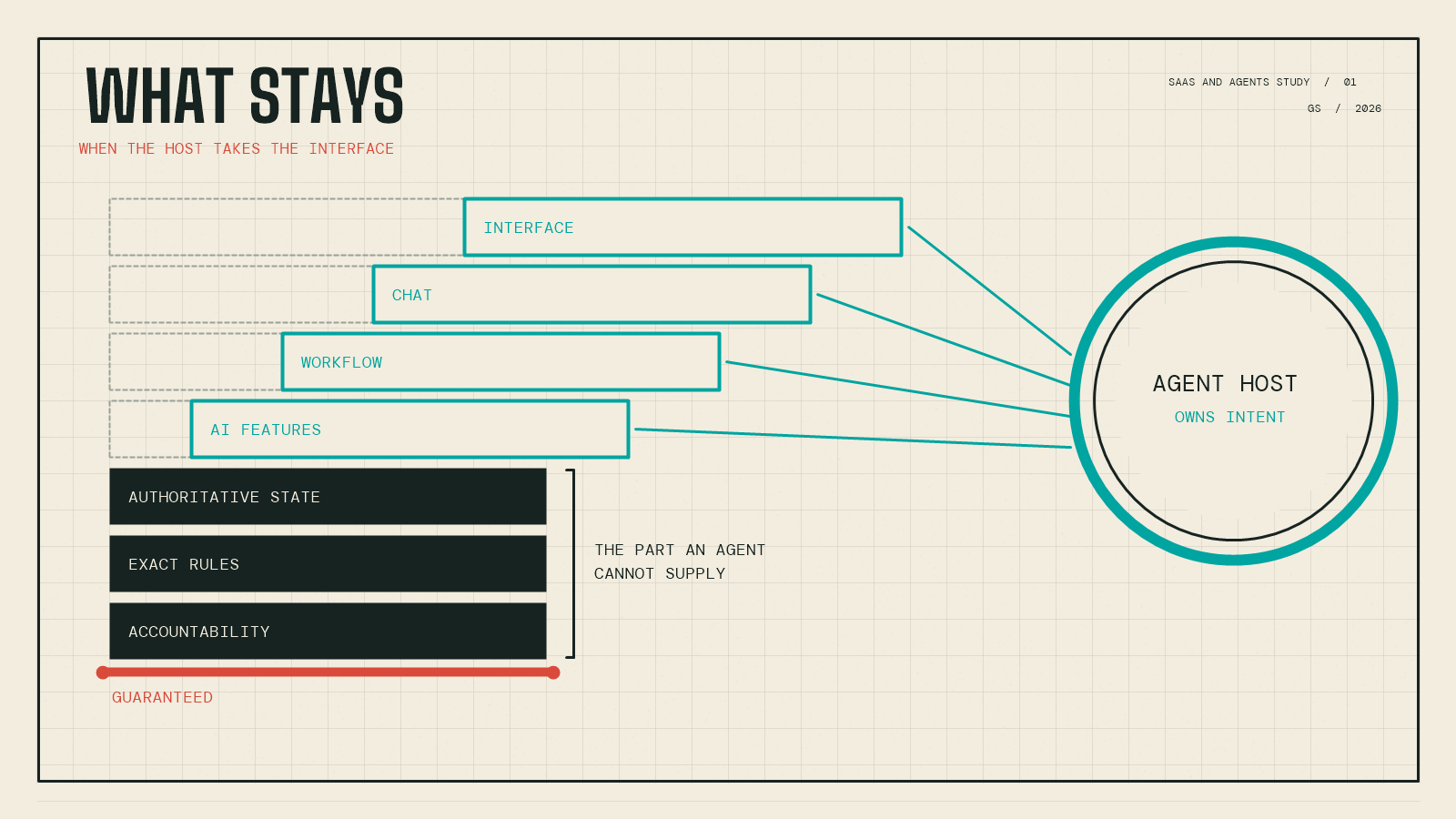
Chat inside your SaaS competes with the assistant customers already use, and exposing your product to agent hosts makes it easier to compare. What stays worth paying for is state, exact rules, and accountability.
Your customers already have an AI assistant. Should your SaaS build another one, or become a tool inside theirs?
Those are the two ways most teams are discussing for making a SaaS product agentic. I think both are problematic, and the real question sits underneath them: when an agent can operate your product, what are customers still paying for?
Two ways in
You can bring AI into your product, either as added value such as analysis and recommendations, or as an interactive chat experience.
Or you can bring your product to the AI: expose its capabilities to agent hosts such as Claude Cowork or GitHub Copilot, so customers can use it without opening your interface.
Owning the screen was never owning the customer
Four roles can sit in different companies: the interface where intent is expressed, the orchestration of the work, the system of record, and the commercial relationship. A host can own the conversation while your SaaS keeps the contract and the authoritative record.
The chat window competes with the host
A chat box inside your product competes with the assistant the customer already uses. That assistant has their choice of model, their files, and their other tools. Yours has one product’s data.
I would not bet that customers pay extra for a narrower version of a conversation they can already have elsewhere.
The integration makes you comparable
The hosts are building the route. GitHub Copilot supports MCP servers across its IDE, CLI, app, and cloud-agent surfaces, and its agent finder searches a catalog of capabilities at runtime and returns ranked matches. Atlassian offers a remote MCP server for clients such as Claude, ChatGPT, Cursor, and VS Code. In Claude Cowork, a customer describes an outcome and Claude works through the connectors they have enabled.
Take a hypothetical property-management product. A host agent can check next month’s occupancy, move a cleaning slot, and draft the guest message without the manager opening a single screen. The host then owns the intent, the conversation, and the orchestration. Your product becomes a set of operations behind a schema, and the host’s model supplies the intelligence.
That is the problem. Choosing the second option appears to make the first one pointless, and it exposes the rest of your product to comparison.
The trap is narrower than it sounds
I do not think “everyone is forced” or “everything becomes replaceable” holds universally.
Not every customer will be in a host. GitHub’s policy for MCP servers in Copilot is disabled by default for Business and Enterprise organizations.
Vendors also set the terms of access. In 2025, Slack limited new commercially distributed apps outside its Marketplace to one request per minute and 15 messages per request on two history methods, citing bulk data exfiltration. Approved Marketplace apps were unaffected.
And a shared protocol is not a shared product. A tool call is the smallest part of a replacement. A competitor must also reproduce your history, permissions, integrations, and compliance record before a customer can switch.
My bet is that agents commoditize the interface and workflow layer first. A product that is mostly screens over simple operations is exposed. A product that holds the authoritative record is much less so. Whether hosts will pick between competing vendors per request, rather than use the connectors that users or administrators configure, remains a risk and not an established practice.
What is left to sell
When the interface and the intelligence can both come from the host, three things remain hard to supply:
- Authoritative state: the record and history nobody can reconstruct from a chat transcript.
- Rules that must be exactly right: permissions, availability, calculations, and compliance. A model can propose; your software must decide.
- Accountability: someone answers when the action is wrong.
An agent can request a booking change. It cannot guarantee that the room is not double-booked, produce the audit trail, or take responsibility for the result. That is the product.
Pricing may follow the same logic. Intercom prices its Fin agent from $0.99 per outcome and sells it on other helpdesks with no seat fees. It prices a result, not access to an interface. Whether that fits your product is a separate decision, but customers paying for outcomes someone stands behind is a plausible direction.
Test before you build
For one workflow, ask:
- Could a host’s model do this with a good tool and your data? Then a chat window will not differentiate you.
- What must a replacement reproduce beyond the tool schema?
- If the interface disappeared tomorrow, which guarantee would a customer still pay for?
Build AI inside your product only where it depends on something the host cannot see: your product’s feedback loop, or an outcome you will be accountable for. Expose to hosts the capabilities that carry your guarantees, not a thin wrapper around create, read, update, and delete.
The answer is often a hybrid. Offer bounded routine actions to hosts, keep expert investigation and exceptions in your own experience, and make both surfaces use the same domain rules and execution controls, not a more permissive agent path.
The goal is not to preserve every click. It is to remain worth choosing when the clicks disappear.
Discussion Prompt
If an agent could operate every screen of your SaaS tomorrow, would customers still pay you for a workflow or for a guarantee?