The Best AI Model Is the Wrong Question
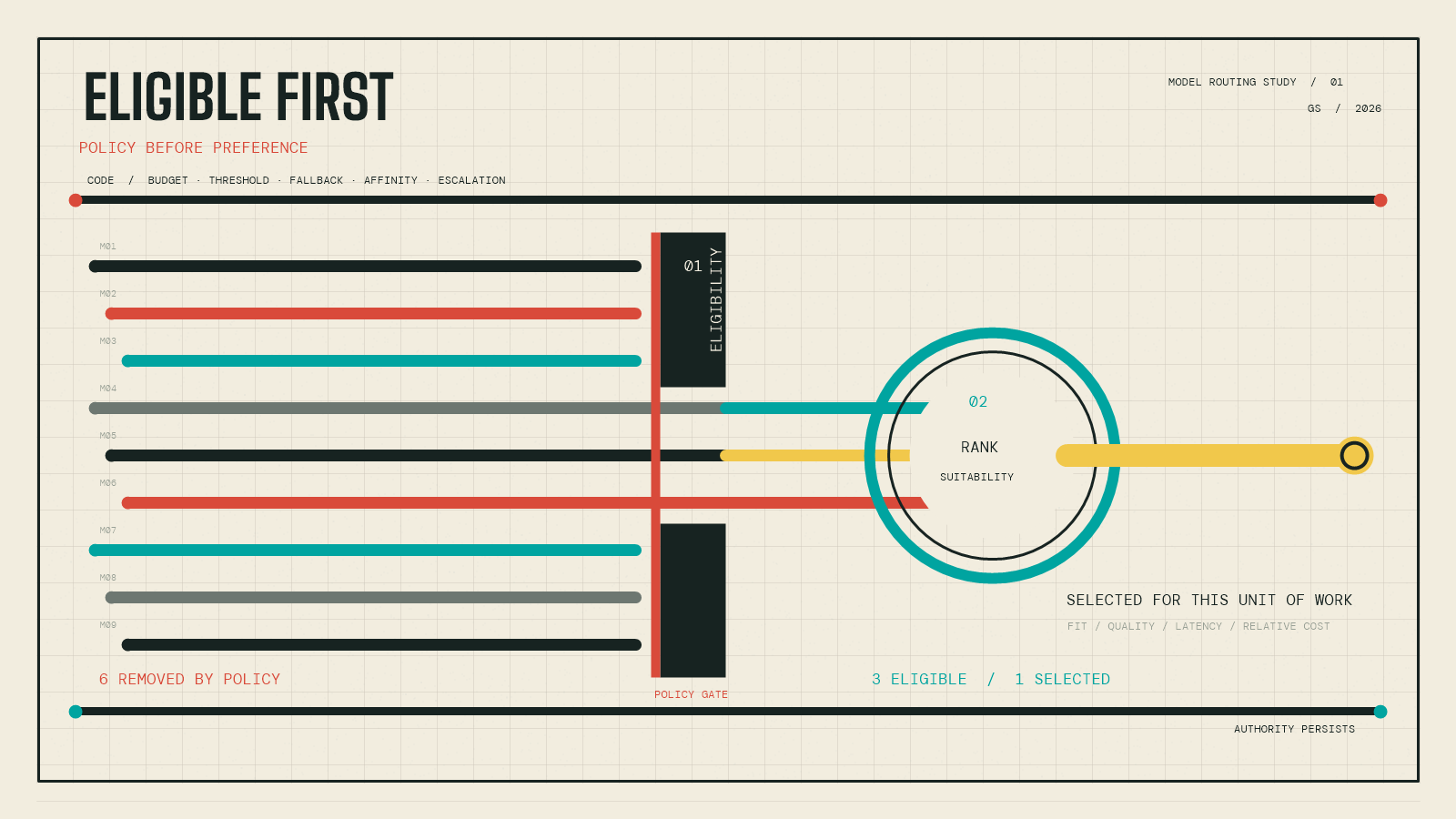
Agent model routing should filter by hard policy first, rank eligible candidates second, and leave budgets, thresholds, fallback, affinity, and escalation under code control.
The best AI model is the wrong question.
Ask an agent to investigate a production incident and it may inspect a screenshot, trace code, propose a patch, and verify the result. Those are different kinds of work with different risks. Treating the entire request as one prompt hides the decision that matters:
Which model should handle this unit of work, under the constraints that apply now?
Model routers already make part of this practical. Microsoft Foundry routes eligible models using prompt attributes and quality-cost modes. OpenRouter classifies tasks, applies model and provider restrictions, then builds a primary choice and fallbacks. LiteLLM supports heuristic, semantic, LLM, and typed decision classifiers, plus fallback and session affinity.
The next architectural step is not a more impressive picker. It is putting routing inside the agent trajectory without surrendering control to it.
One request becomes several routing decisions
An agent request is rarely one stable task. The harness plans, calls tools, observes results, and revises its approach. A screenshot introduces a modality requirement. A tool result can raise the data classification. A proposed code change may be routine until it touches authentication or payments.
Routing only once at the beginning assumes those changes do not matter.
But rerouting every model call would be wasteful. Classification has a cost. Switching models can lose prompt-cache value and introduce coherence problems. Some sessions should stay pinned to one model.
The useful boundary is therefore a meaningful unit of work: a step whose task, modality, risk, data policy, or required capability differs enough to justify a new decision. The harness, not the model, defines that boundary.
Eligibility must come before suitability
Routing needs two mechanisms because policy and preference answer different questions.
First, code determines eligibility. A model is either allowed to process the current data or it is not. The provider is approved or it is not. The model supports the required modality and context or it does not. The request fits within an absolute budget ceiling or it does not.
These are hard constraints. They remove candidates before semantic ranking begins.
Then the router evaluates suitability among the eligible models. Which candidate best fits the task? How much quality does this step require? What latency is acceptable? Is a coding specialist useful? Is a cheaper model sufficient?
Relative cost belongs here as an optimization criterion. An absolute spend limit belongs in eligibility. Blending the two lets a persuasive score compensate for a rule that should never be negotiable.
This ordering also makes the system easier to defend. The router cannot recommend an unapproved model because it never sees one as a valid option.
Judgment can be learned; authority stays in code
Suitability ranking does not require one universal technique. A heuristic may handle obvious tasks. A small classifier may select a complexity tier. A learned router may improve from measured outcomes. A typed decision model such as TypeSafe’s Jev can choose from a defined eligible set and return probabilities and confidence.
None of those mechanisms should own the workflow.
Code owns the catalog, budget, threshold, affinity rule, fallback, and escalation path. Low routing confidence might select a safe default, preserve the current model, invoke a stronger classifier, or require human review. A failed classifier must not invent a route. A model switch should happen only when its expected value exceeds the decision cost and any cache loss.
This is the strongest boundary in the design: semantic judgment advises; deterministic software authorizes and acts.
Optimize the system, not the benchmark
The obvious counterargument is that one strong general model is simpler. It avoids router errors, preserves context, and reduces operational complexity. For small workloads or tightly coupled sessions, that may be the better architecture.
Multi-model routing earns its place only when the workload is varied enough and the differences in policy, capability, quality, latency, or cost are material. The evaluation must include the router’s own latency and cost, fallback frequency, cache effects, task outcomes, and policy violations. Model benchmark scores alone cannot answer that question.
The model picker will not disappear. It will move behind the harness, where it becomes a governed catalog rather than a recurring user decision.
The future is not one model winning every task. It is software buying exactly the capability each step needs, from the models it is allowed to use, under controls the organization can explain.
Discussion Prompt
Where would you draw the routing boundary in an agent: once per request, once per turn, or only when the work changes materially?