Customer Feedback Is an Input, Not Your Product Strategy
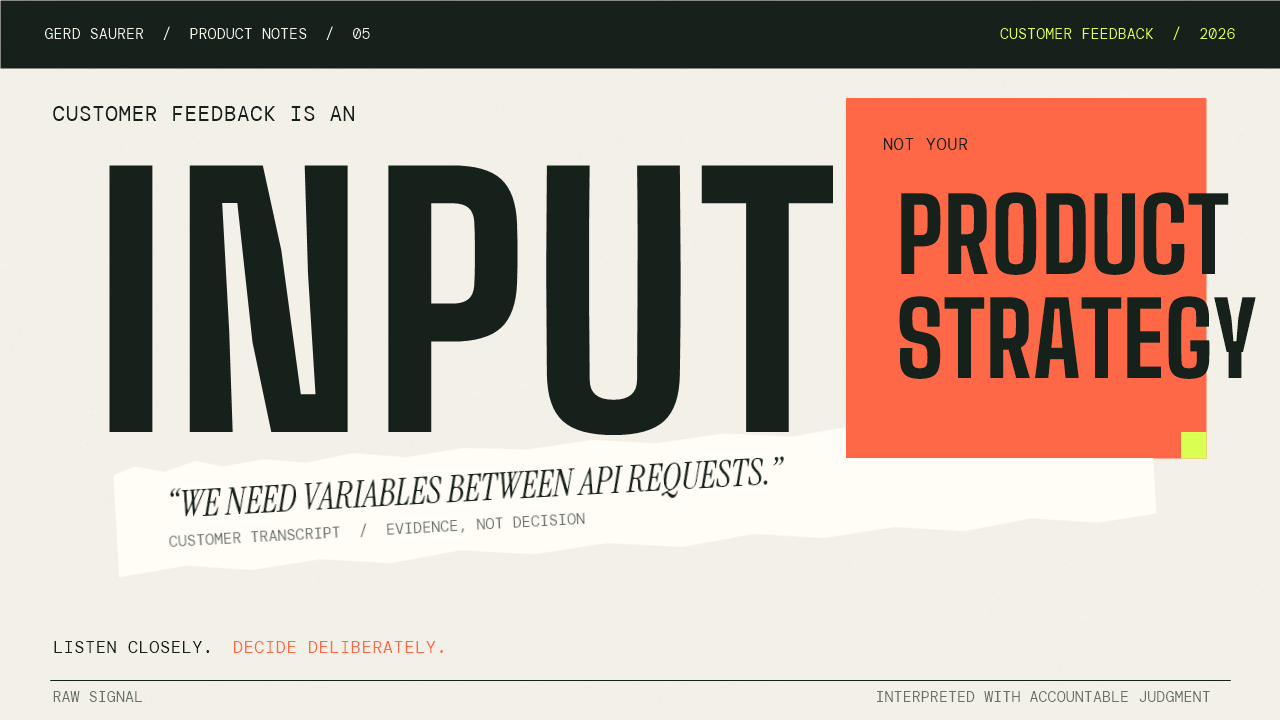
Customers describe valid needs through the product they know. Product strategy decides which underlying outcome the product should own and at what level to solve it.
Customer feedback is essential to product management. But building what customers ask for is not product strategy.
That distinction is becoming more important as AI makes collecting, transcribing, clustering, and summarizing feedback increasingly cheap. Turning requests into requirements is useful work, but it is no longer the scarce part of product management.
The scarce part is judgment: understanding why the request exists, abstracting the underlying problem, placing it in the context of the product, and deciding what the product should own.
Customers Start From the Product They Have
Customers usually describe a solution within the boundaries of the product they use today.
That is reasonable. They know their workflow and the obstacle in front of them. They may even have designed a precise extension that would remove it. Sales teams often reinforce this framing because they need to unblock a deal or retain an account.
The request can be valid while still pointing to the wrong product decision.
If product management converts each request directly into a requirement, the roadmap becomes a collection of locally reasonable answers. Over time, the product accumulates settings, exceptions, concepts, and support obligations that solve individual cases but do not strengthen a coherent whole.
Fragmentation is not simply having too many features. It is solving related problems at inconsistent levels of abstraction.
The Same Request Can Need Two Different Answers
Imagine a booking platform that supports outbound API calls but does not support online payments. A customer connects a payment provider through the API. The provider requires a token from one request to be reused in the next.
The customer asks for persistent variables between API calls.
For an automation platform, that may be exactly the right capability. Stateful, multi-step requests are part of its core job. A reusable variable primitive improves many workflows without making the platform responsible for payments.
For a booking platform, the same answer may be a distraction. The underlying customer problem is not variable storage. It is collecting payment as part of a booking.
Adding variables would help this customer assemble a workaround, but it could pull the booking product toward becoming a general-purpose automation engine. Meanwhile, the product would still not own payment state, refunds, failed-payment handling, reconciliation, or the relationship between payment and reservation status.
The stronger product decision may be to make payments an integral part of the booking lifecycle.
The request is identical. The correct answer depends on the product’s domain, promise, and intended boundary.
Move Up Before You Decide
Before turning feedback into a requirement, I try to move through five questions:
- What solution did the customer request?
- What obstacle are they trying to remove?
- What outcome are they trying to achieve?
- Which other users or workflows share the underlying problem?
- Is that outcome something our product should own?
Only then should the team choose the response. It might be a domain capability, a reusable platform primitive, an integration, a small extension, a documented workaround, or a deliberate decision not to build.
Abstraction does not always mean making something more generic. In the booking example, the more useful abstraction may be the deeper vertical capability: payment as part of booking. In the automation product, it may be the horizontal primitive: state that can move through a workflow.
AI Raises the Value of Product Judgment
AI can already process more customer feedback than most teams could review manually. It can extract requests, group themes, connect them to accounts and revenue, summarize interviews, and draft requirements.
That is valuable. It also makes a narrow interpretation of product management easier to automate.
The response should not be to listen to customers less. Product vision without customer evidence becomes speculation. Nor should product managers reject proposed solutions merely to demonstrate strategic thinking. Customers often understand their domain better than the product team, and sometimes the requested feature is the right answer.
The job is to separate evidence from decision.
Feedback tells us where reality conflicts with the product. Product management determines what that conflict means for the product as a whole.
Always ask why the customer wants something. Then ask what level of the problem belongs in your product.
A roadmap built directly from requests may look customer-driven. A product built from understood problems has a better chance of becoming coherent.
Where has the same customer request led to a different product decision once you considered what the product should actually own?