I'm Not Vibe Coding — I'm Guide Coding
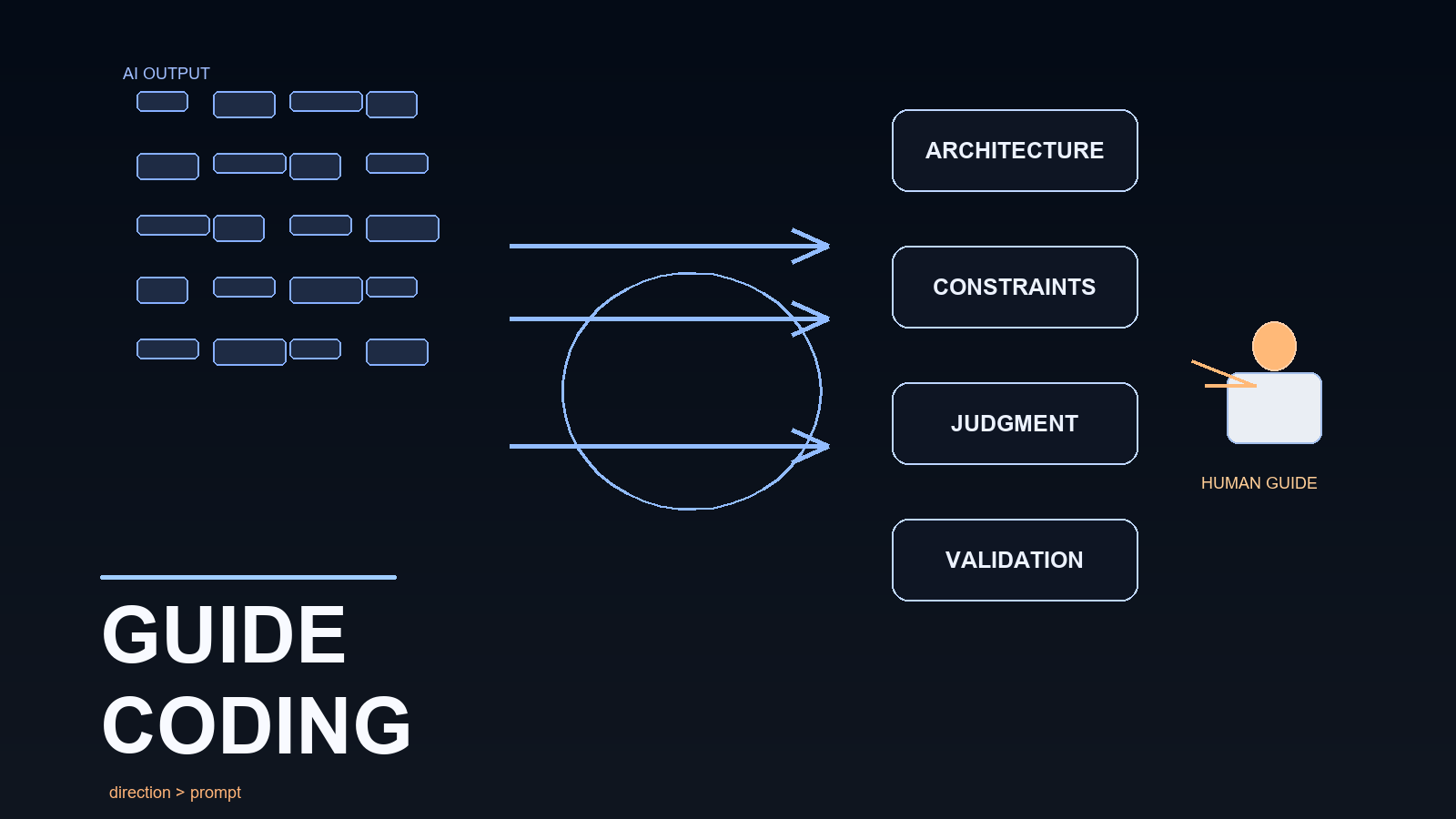
AI can generate plausible software quickly, but the human still defines the architecture, constraints, quality bar, and final decision.
There is a lot of language around AI-assisted development right now, and some of it is lazy.
The most misleading phrase is probably “vibe coding.” It sounds simple, modern, and productive. In practice, it often means: throw a prompt at an LLM, accept the result, and hope the software mostly works.
That is not what serious AI-assisted development looks like.
I am not vibe coding. I am guide coding.
That distinction matters because the point of AI is not to remove engineering judgment. It is to amplify it.
A model can generate lots of plausible code quickly. It can propose solutions, mock up flows, and draft implementations at a speed no human team can match. But the quality of the output depends on your ability to steer it. You still have to know what good looks like. You still have to decide what constraints matter. You still have to notice when a result is plausible but wrong.
A single prompt is not a project plan. A generated patch is not a product decision. A clean-looking response is not proof that the system is correct.
The real job is not “tell the AI to do the work.” The real job is ongoing direction: ask the right questions, inspect the output, redirect when it drifts, tighten the requirements when they are too loose, and reframe the problem when the first answer is solving the wrong thing.
That is guide coding.
A useful analogy is an architect and a junior engineer working together.
A junior engineer is fast. They can generate a lot of output quickly. They improve as they receive feedback. But they also make weak assumptions, miss hidden constraints, and produce plausible work that still needs correction.
An architect does not do all the work by hand. They keep the team pointed in the right direction, challenge flawed reasoning, tighten requirements, define trade-offs, and decide when a result is good enough or wrong in a fundamental way.
AI behaves a lot like a junior engineer who can move fast and produce a lot of plausible output. The difference is that it does not become better just because it wrote a lot of code. It becomes better because the human acts as the architect: guiding the system, correcting it, teaching it the standards, and maintaining the structure of the solution over time.
That is why the real leverage is not “better prompting.” It is repeated interaction with a clear architectural standard.
The difference is judgment, not prompting
People talk about “prompt quality” as if the trick is magic words. It is not.
A good prompt helps. A good process helps more. What matters is that someone is maintaining the standard for what counts as a correct result.
Good AI-assisted development is iterative and corrective. You review intermediate output. You ask the model to critique its own answer. You challenge assumptions. You split large problems into decisions rather than just tasks. You know when to accept a result, when to rewrite it, and when to abandon a direction entirely.
This is not fundamentally different from how good engineering work happens with human collaborators. A developer does not hand off a vague ticket and expect perfect implementation without follow-up. There is review, clarification, feedback, and refinement. The interaction model changes. The quality discipline does not.
The model will often produce an answer that looks polished and still misses the real goal. The human must still decide: does this solve the user problem? Does it fit the architecture? Is it safe? Will it break under edge cases? Does it match the product constraints?
That is not prompting. That is engineering judgment.
Why “vibe coding” is a useful myth
The phrase “vibe coding” makes AI development sound like a freeform art project. It turns real engineering work into a feeling: “I prompted it, and it felt right.”
But software is not just a vibe. It has requirements, constraints, and consequences.
If a system affects access control, permissions, financial data, reliability, latency, or operational safety, the quality bar is not “it seemed clever.” The bar is “it works, under constraints, with evidence.”
The human provides the standard. The AI accelerates the search for options and the generation of drafts. The human enforces quality.
That means the AI is not replacing the developer. It is acting more like a highly capable, very fast junior teammate with a tendency to sound confident even when it is wrong.
You are still responsible for the outcome. You still need to inspect, validate, test, and redirect.
The real skill is managing the model, not worshipping the prompt
Guide coding is not only about fixing code. It is about directing a process.
A good guide coder acts like the architect in the room. They define the goal and constraints clearly, ask for alternatives before committing to a path, inspect assumptions instead of trusting polish, correct the model as it learns their standards, maintain architectural intent as the work evolves, and decide when a result is good enough and when it is still wrong.
This is the same pattern as working with junior developers. They are fast. They produce a lot. They improve when you interact with them repeatedly and give them quality feedback. The more you teach the model your standards, preferences, and constraints, the better it becomes at serving your way of working.
The human is not just a reviewer. They are the one deciding what the system should become.
That is not “vibe coding.” That is architectural leadership in the age of AI.
The tools have not changed, and neither has the need for evidence
Some people act like AI means we no longer need tests, reviews, or strong validation. That is nonsense.
Guide coding does not remove the engineering process. You still test. You still read the diffs. You still reason about failure modes. You still validate the user experience and the business logic. You still make trade-offs between velocity, clarity, and correctness.
The source of the code does not change the need for evidence. A model-generated function is still a function. It still has to satisfy the requirements. It still has to be reviewed. It still has to be patched when it fails.
When I work with AI, I do not ask it to be the engineer. I ask it to help me think faster.
I define the goal. I specify the constraints. I ask for alternatives. I inspect the trade-offs. I challenge the output. I refine the direction. I keep the task anchored to the business and product realities.
That is guide coding.
It is not glamorous. It is not magical. It is disciplined.
And it is the difference between using AI as an amplifier of engineering skill and using it as a way to outsource responsibility.
The best AI-assisted developers are not the ones who can generate the most code from a single prompt. They are the ones who know how to guide the process so the result is correct, maintainable, and valuable.
The future is not vibe coding. The future is guided intelligence, clear standards, and decisive human leadership.
That is what I do.
If you are using AI in software development, stop asking whether the tool can generate a solution and start asking whether you are guiding the right decision-making process.
The real advantage is not in the prompt. It is in the judgment behind it.
Where are you still treating AI like an autocomplete engine when it should be treated like a fast junior engineer inside an architecture you own?