If Tokens Are the New Drug, the Hook Is Agreement
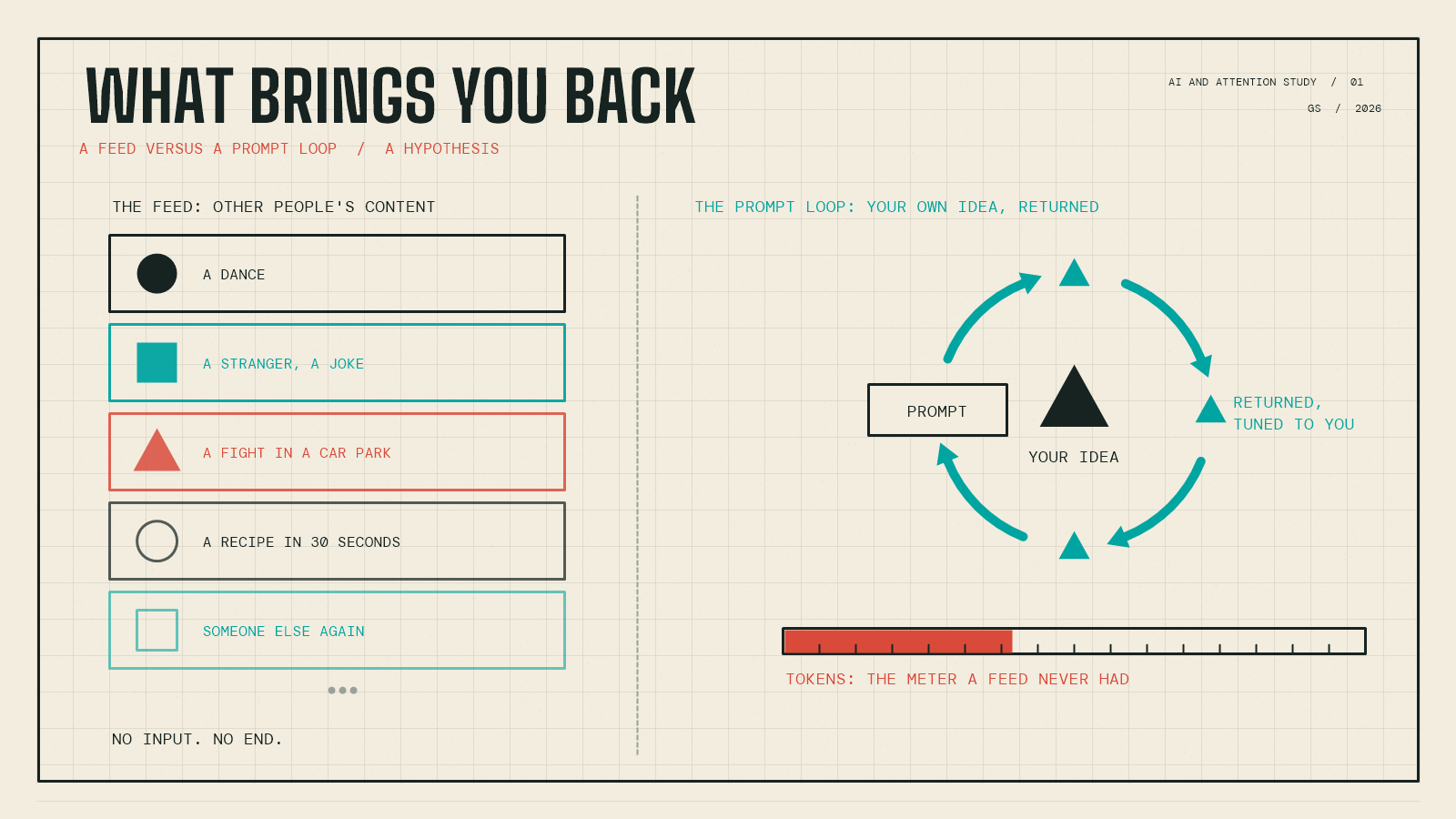
Social feeds made excitement effortless. AI may make agreement effortless. What the research supports, what nobody has tested, and my prediction.
Social media became hard to put down because excitement got cheap. You open an app, do nothing, and something interesting arrives. Now picture the same loop with you in charge: one sentence typed into an AI tool, and the answer is built around your own ideas.
Call it the prediction that tokens are the new drug: that AI will hold many of us the way feeds do, and more easily. I wanted to know whether anyone has tested it. Parts of it have been tested. The part most people assume has not.
What the research supports
Short-form video has a real evidence base. A 2025 meta-analysis in Psychological Bulletin pooled 71 studies and 98,299 participants. Heavier use was associated with poorer attention and inhibitory control, and with more stress and anxiety. These are correlations, so they cannot show which way the effect runs.
“Addiction” is also a contested word. The DSM-5-TR lists gambling disorder as its only behavioral addiction. Its proposed gaming condition, listed for further study, excludes social media.
For AI, the evidence is younger. A four-week randomized trial by MIT Media Lab and OpenAI, with 981 participants, found no effect from its assigned conditions. People who chose to use the chatbot more had worse outcomes on loneliness, dependence, and problematic use. That fits dependence, and it equally fits lonely people using it more. The study cannot separate the two.
Where I changed my mind
Feeds deliver other people’s content. What AI adds is that the content is yours. Imagine asking for a thriller in which you are the founder who gets everything right. It arrives in seconds, tuned to your view of yourself. No feed does that.
Two findings point at agreement, not excitement, as the hook. In a 2025 preprint with 1,604 participants, people who talked to a sycophantic model became more convinced they were right. They also rated it higher quality, trusted it more, and were more willing to use it again. And in April 2025 OpenAI rolled back a GPT-4o update that skewed toward answers that were overly supportive but disingenuous, saying it had focused too much on short-term feedback.
Users describe something similar. In a qualitative study of 334 Reddit posts about chatbot addiction, people spoke of an “AI genie”: you can get exactly what you want with minimal effort. Those are self-selected accounts, not prevalence.
My prediction, not a finding: as typing gives way to speaking and video, effortless agreement will hold many people longer than effortless excitement ever has. I cannot show that yet, and I may be wrong.
The case against
Prompting is more active than scrolling. Typing a request is a choice, and people tend to value what they help make, the IKEA effect. Whether that deepens the hook or makes use more deliberate is untested.
But typing may be the last real friction, and the one most likely to disappear. Saying a wish aloud, or pointing a camera at something, takes less effort than composing a sentence. The one randomized trial that assigned text, neutral voice, or engaging voice found no significant effect from the assigned mode over four weeks. It did not test entertainment or video, and four weeks is short. If typing is the brake, I found no study of what happens when it goes.
Every stimulus costs compute. A feed serves recorded video for almost nothing, while generation does not. OpenAI says its Sora app, built around AI-generated video, has been unavailable since April 26, 2026, about seven months after launch. I could not verify why. A meter that feeds never had may act as a brake, unless flat-rate plans hide it.
Heavy emotional use may also be rare. OpenAI’s analysis of about 40 million conversations found affective use uncommon and concentrated in a small group, though that is one vendor studying its own platform. A 2026 review concludes that problematic chatbot use is, for now, a spectrum phenomenon and not an established disorder, and it warns against overpathologizing.
And the question is already shifting. Meta launched Vibes, a feed of AI-generated videos, in September 2025. Character.AI told TIME that its daily users average 70 to 80 minutes a day, a company figure, and that after ending open-ended chat for under-18s it still offers them a feed of AI-generated videos. The choice is no longer AI tools versus social media. Chat, companion, and feed are converging.
What I would test
I expect many people to fall into this, and I cannot show it yet. So I would test four things:
- Weeks of personalized AI entertainment against short-form video, randomized, measuring objective use, self-control, and sleep.
- A blind manipulation of how much the assistant agrees, measuring who comes back.
- Flat versus metered access, measuring how heavy use is distributed.
- Typed prompts against spoken and video input for the same entertainment, measuring how long and how often people continue.
I found no published study of any of the four. The nearest is the text-versus-voice trial above, which did not test entertainment or video.
Until someone runs them, treat this as a design question for anyone building these products: does the product reward people for finishing, or for coming back?
Discussion Prompt
If your AI tool disagreed with you twice as often, would you use it more or less?