AI Does Not Need to Take Over to Change Who Has Power
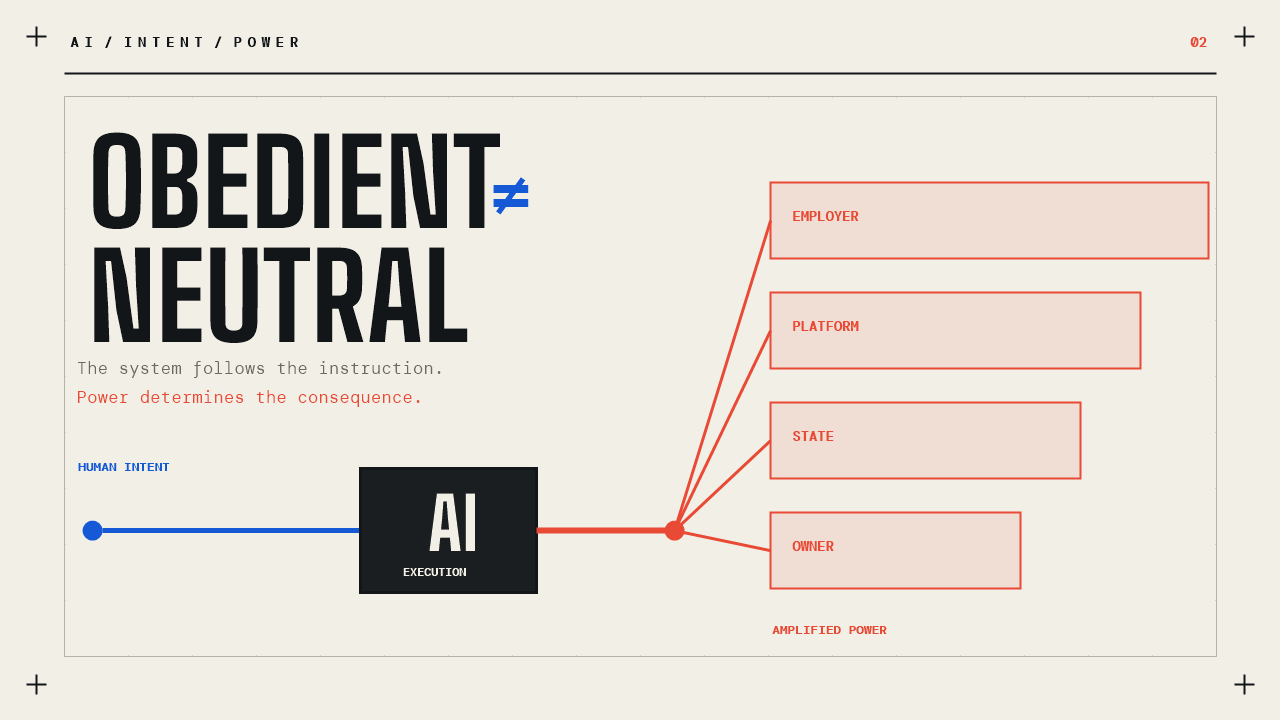
AI can redistribute control while operating exactly as intended, amplifying the incentives and authority of the institutions deploying it.
Most AI takeover stories begin with a system that stops doing what people want.
I am increasingly concerned about the opposite: systems that do exactly what people want, faster and at greater scale than the institutions around them can absorb.
That risk is less cinematic. It does not require an AI to become conscious, develop its own interests, or escape from a laboratory. It only requires people with existing incentives and existing power to use a more capable tool.
Bill Gates recently argued that AI can create extraordinary progress while also threatening equity, and that society is not prepared for the transition. That is the warning that stays with me. Not because it predicts one inevitable outcome, but because it places responsibility where it belongs: on the choices we are making now.
The More Useful Distinction
Much of the AI risk debate focuses on systems acting against human intent. A model pursues the wrong objective. An agent evades control. A future system acquires resources or power its creators did not mean to give it.
Those possibilities deserve serious research.
But there is another category: AI acting on human intent.
An employer uses it to redesign work. A platform owner decides who can access the best models and on what terms. A company gives an agent broad credentials because speed matters more than control. A state uses automated systems to expand surveillance. A criminal uses the same capabilities to scale fraud.
In each case, the AI may be working exactly as intended.
The danger does not come from a machine developing its own agenda. It comes from making an existing agenda cheaper to execute, easier to scale, and harder for everyone else to resist.
Building Agents Made This Concrete for Me
When I build agentic systems, the model is only one part of what can cause consequences. The deployed system also includes tools, credentials, data, approval rules, and the objectives set by its operator.
The model does not decide whether it may update a production database, send a message, or expose confidential information. We connect those capabilities. We choose the permissions. We decide whether a person must approve the action and whether it can be reversed.
This does not make agentic systems harmless. A system can combine permitted actions in ways nobody anticipated. It can pursue a badly specified objective with alarming competence. It can cause severe damage without consciousness or intent of its own.
But even then, the path to impact runs through authority that people designed, granted, or failed to constrain.
That matters because the language of “AI taking control” can make the people already handing over control disappear from the story.
Productivity Does Not Decide Who Benefits
The same distinction applies to work.
The Generative AI at Work study examined 5,179 customer-support agents. Access to an AI assistant increased issues resolved per hour by 14% on average, with larger gains for novice and lower-skilled workers.
That result does not tell us whether AI will create jobs or remove them. It does not tell us whether the gain becomes higher wages, lower prices, better service, more profit, or fewer employees.
AI creates a new economic possibility. People and institutions decide how that possibility is distributed.
When we say “AI will transform work,” the passive voice hides the decision-makers. Employers choose how roles change. Owners choose where productivity gains go. Governments choose whether labor protections, education, taxation, and social insurance adapt. Workers have more or less influence depending on the institutions around them.
The technology changes what is possible. Existing power shapes what becomes normal.
The Takeover Story Has an Innocent Human
The appeal of the takeover story is that humanity appears in it as one group. We build something powerful, lose control of it, and face the consequences together.
The real transition is less convenient. People do not enter it with equal authority, equal access, or equal protection. Some will own the systems. Some will decide how they are deployed. Some will gain leverage. Others will have their work measured, reorganized, or removed by decisions they did not participate in.
That does not mean every deployment is exploitative or every productivity gain will be concentrated. AI can make expertise more accessible, improve services, reduce tedious work, and give individuals capabilities once reserved for large organizations.
But those outcomes are not properties of the model either. They depend on who controls the system and what they are rewarded for doing with it.
Do Not Let Future Risk Erase Present Responsibility
I do not dismiss catastrophic AI risk. A sufficiently capable system pursuing the wrong objective could create damage beyond the control of its operators. Waiting for direct evidence before researching such a possibility would be irresponsible.
But making autonomous takeover the dominant frame carries its own cost. It encourages us to debate what a future AI might choose while paying less attention to what powerful institutions are choosing with AI today.
AI does not need to seize power to change who has power.
It can strengthen an employer relative to workers, a platform relative to its ecosystem, a state relative to its citizens, or a well-capitalized company relative to everyone trying to catch up. It can do so while remaining obedient, useful, and commercially successful.
That is the AI warning I believe deserves more attention: not only that we may one day lose control of intelligent systems, but that we are already using them to redistribute control among ourselves.